-
Links
-
-

-
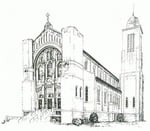
Our Lady of Consolation ChurchRev. Fr. Joseph Bessette, the first and founding pastor of Our Lady of Consolation Church, Pawtucket, RI, was promoted to the honor of Prothonotary Apostolic by his Holiness Pope Pius XI, at the request of the Most Rev. William A. Hickey, Bishop of Providence. His investiture was to have taken place on April 19, 1925, but unfortunately Father Bessette passed away before he could receive the honor. On April 16, Father Bessette, one of the state's oldest clergymen at the time, died after being ill for some time.
Father Lafayette was named administrator to the parish while Father Bessette was ill. Father Joseph Claver Bessette was laid to rest in our church yard on Monday morning, April 20, 1925, the day after he was supposed to celebrate his investiture.
Msgr. Joseph Claver Bessette was born in Saint-Gregoire d'Iberville on the 16th day of December 1851. He studied at the College of Marieville and at the Grande Seminary in Montreal. He was ordained a priest on July 26, 1878 by Bishop Moreau of the Diocese of Saint-Hyacinthe. He was immediately appointed a professor of philosophy at the College of Marieville (1878-1882). He soon left for Rome for advanced studies and returned in 1885 with doctorates in theology and canon law. He immediately returned to Marieville to teach theology in 1886-1887. He then left teaching for parish ministry and was appointed pastor of Saint Prudentienne (1887-1889). He arrived in the United States in 1889 and was appointed successfully at St. Mathieu's, Fall River (1892-1894); and Sacred Heart, New Bedford, MA (1894-1895). Bishop Harkins then commissioned him to establish the new parish of Our Lady of Consolation.
Without a doubt the high point of Monsignor Bessette's life was the construction of his new church. The old church was moved to Webster St. on May 22, 1922 at a cost of $1900. The building came to be used as our parish hall. The altar was given to St. Theresa's Parish in South Attleboro, MA. It was used in their temporary chapel and later installed in their first church.
Work began on Our Lady of Consolation's new edifice on August 8, 1922. Bishop Hickey placed the cornerstone on Thanksgiving Day, November 23, 1922 and Father Rotique Chinard of Fitchburg, MA preached the sermon.
The building cost $170,000. The dominating feature of the building was its tall bell tower which later had to be shortened for safety reasons. The architecture of the building is outstanding.
At first, in keeping with its style, there were no statues. The side altars were highlighted by icons of Christ the King and St. Anne. Unfortunately, the icons were painted over, destroying two beautiful treasures. In their place now stand two statues, one of the Virgin Mary and the other of St. Joseph. The stained glass windows have thankfully remained intact. These Bavarian windows are some of the most beautiful in America. The windows in the main body of the church and above the altar depict the fifteen mysteries of the rosary. The church is very beautiful and is certainly a great memorial to Monsignor Joseph Claver Bessette.
In 1953 the interior of Our Lady of Consolation was greatly changed. The original painted decoration of the ceiling and walls was executed in Al Fresco for the pictures and Al Secco for the ornaments and flat surfaces. This technique was one used almost exclusively in the Middle Ages for church decoration and Michaelangelo used it himself in his rendering of the Sistine Chapel. -

-
Sacred Heart of Jesus ChurchEstablished in the Pleasant View district of Pawtucket. It was formed from the community of St. Mary's in Pawtucket which was thriving at the time of its formation.
In August of 1871 in Union Hall in the Bowery section of Central Falls, the Sacred Heart of Jesus Parish held its first service. A weekly Visitor article in 1873 described the church this way:
"The front of the church, which is on Park Street, will be ornamented with five large windows, graduating in size, as before stated, of stained glass monograms and figures in stationary lead sash. At the left corner will be a square tower, buttressed, reaching above the level of the building surmounted with an octagon tower resting on a brooch, and on this last tower will rest a gothic spire, octagon in shape, with gothic spire lights and crockets. The spire will be surmounted with a cross, the top of which will be 125 feet from the ground."
Rev. James L. Smith was the first pastor but stayed only two years and was succeeded by Rev. Michael Fitzgerald.
A great deal of building occurred in those early decades, with a rectory, convent and school adjoining the original wooden church. In 1913, Rev. Louis Deady followed a trend of those times and made the church more permanent by bricking it over - veneering as it was called. Other area churches - St. Joseph, St. Patrick and St. Margaret were also veneered. A 100-year history celebrating the parish jubilee reported "the spire of the church was rebuilt and made firm for the interest is incorporated in the brickwork of the transepts, forming crosses within each the idea being to recall the three crosses of Calvary."
On January 18, 1953, a fire reportedly started by faulty wiring destroyed Sacred Heart Church. Ed Broadmeadow and his son Joseph, Irene Fallon, Frank Conlon and John Hathaway helped Rev. John Flanagan rescue various sacred articles. John Acheson also helped, only ten hours after watching two of his grandchildren baptized in the church.
Church parishioners Catherine Carter, Ann Parkinson, Theresa Acheson and Cathy Childs lived in the neighborhood at the time and remember how devastated everyone was...People viewed the ruins and cried. "The fire was a sad, sad thing," Ann Parkinson recalls, "like losing your home." Gloria Kanakry (Duffy at the time) remembers hearing the news at work. She called Sam, her fiancé, who lived just down the street from the church. He had not yet heard, but a while later he called back to confirm the bad news that the church where they were scheduled to be wed was in ashes. They were married at St. Basil's Syrian Melkite church nearby, with a Catholic priest performing the ceremony.
Everyone rallied to rebuild Sacred Heart and attended Mass at Tolman High School Auditorium in the interim. Rev. Robert Cassidy spearheaded the drive to rebuild and modernize the church. The May 13, 1955, Pawtucket Times reported that the church "incorporates the best features of contemporary styling construction and ornamentation. Its severe exterior lines are broken in front by a massive statue of the Sacred Heart set in a niche above the main entrance. Among the many features of the church proper are the new-type stations of the cross and glass block windows. Instead of customary tablets, the stations are designed as a frieze around the wall, painted in gold on a black background. The glass block windows, largest of their kind in the country, are highly decorative and allow more light into the church."
Father Cassidy adroitly hurdled Bishop Russell McVinney's reported opposition to air conditioning by arranging to have windows that didn't open. In those less environmentally conscious days, there was little concern about electrical or oil costs and the building was designed to have the heat or air conditioning on at all times. Original Sacred Heart Church, Pawtucket R.I.
 -

-
Saint Joseph Church
 Saint Joseph Church, Walcott Street Pawtucket, R.I.
The first Mass was celebrated on April 1, 1874. A struggle in the early days involved money. The parish had run up a $52,000 debt on the church property and cornerstone, a debt that seemed even more severe because the parishioners were not wealthy. Yet, during the parish's first year, $27,000 was raised - $10,000 at a church fair. Much of the credit had to go to the pastor, who knew not only the value of a dollar but how to raise a few.
During Mass, Father Kinnerney would publicize contributors from the pulpit. It was effective - and humorous. For instance, "John McGuire, the man who puts roofs on houses gave..." "Ned Smith, the man who takes the roofs off the houses gave..." Smith owned a barroom.
Meanwhile, Patrick Farrell was busy putting the roof on the new church. He was the contractor but helped the parish in other ways too. During construction, he let Father Kinnerney keep his vestments at the Farrell home at 27 South Bend St. Finally, on November 10, 1878, the completed church was dedicated. By 1891, the belfry had been raised and the rectory built.
In the 1960s, the pastor came up with a plan: convert half the church basement into a hall and leave the other half as a chapel for daily Mass. So, in August and September of 1976, James Croakrin went to work in the basement, as he had in 1967. This time, however, he had a crew of parish workmen. They removed pews from one half, tiled the floor, and put up a partition. They also installed a kitchen in the rear. Once the work was done, activities and fun began. There were bingo games and line dancing, suppers, and cake sales. A senior citizen's group formed and a babysitting service was offered in the hall during the 10:30 a.m. Sunday Mass.
In February 1977, the parish work detail completed a reconciliation room, face-to-face with the priest. The large statue of the Blessed Mother holding the crucified Christ was moved into the room along with kneelers and vigil lights. Father McElroy was always devoted to the Blessed Mother, leading the recitation on the rosary before his weekday Masses. He was always concerned, too, about the sick and lonely, visiting them often.
But in August 1977, the entire parish was going to need his encouragement and guidance. It was just before a new deacon, the Rev. Mr. Henry K. Bodah, was to arrive at the parish that a tragedy struck. Cars belonging to the Fathers McElroy and Bolton burst into flames. Fire Chief John McLacken, a parishioner before moving out of the parish, remembered it this way later when talking to a Pawtucket Times reporter. "The carport was like a blowtorch with flames on both sides of it. In no time, the flames had leaped onto the rectory, less than eight feet away. Windows shattered and curtains ignited."
Firefighters succeeded in containing the damage to a first-floor living room and a spare bedroom on the second floor. But while they worked, flames shot out the other side of the carport, toward the church, igniting the roof and spreading inside. Sirens from speeding fire engines woke parishioners. Startled, and shocked, they huddled before the flames and watched. Their church, only months away from a century of service, was dying. But, as they looked up at the majestic steeple and cross, they prayed: If only the steeple would hold, there would be hope.
When the fire broke out, Fathers McElroy and Bolton had been inside the rectory, sleeping. The next morning, staring at the ruins, Father Bolton recalled having been awakened by an explosion: "Then there was this tremendous crackling and breaking of glass. And heat!" Father Bolton tried to escape down the stairs facing the church but retreated when he saw a window smash. He hurried toward the rear and looked for Father McElroy. "But he met me. He was coming to get me", Father Bolton said.
Following the devastating fire, construction of the new church of Saint Joseph began, which still stands today on Walcott Street. -

-
